

⚡️ THIS WEEK’S THESIS ⚡️
Europe has invested heavily in building a domestic battery industry. Yet producing battery cells in Europe remains significantly more expensive than in China.
The obvious explanations are usually higher energy prices and labour costs. Both matter. But they do not tell the whole story.
The evidence points to a combination of materials and components, manufacturing efficiency, yield and scrap, factory utilisation, automation, scale and the difficult economics of ramping up new production.
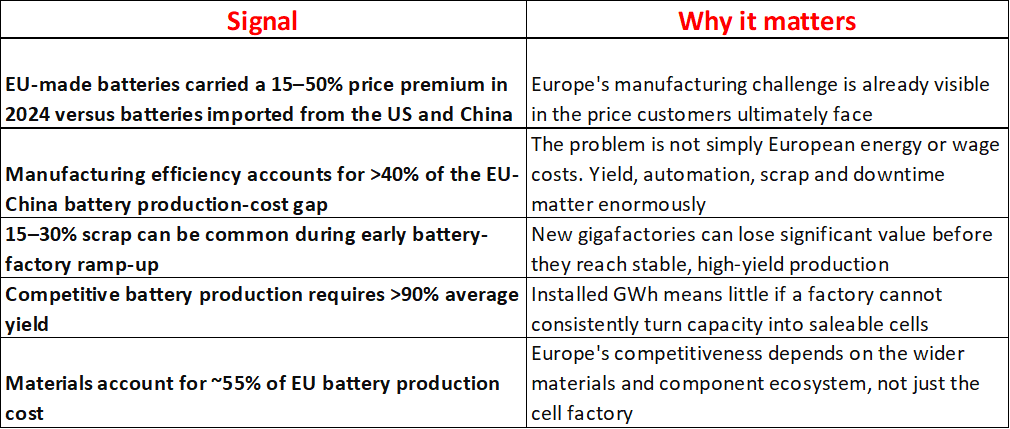
The European Commission‘s JRC 2025 reports that the price premium for EU-made batteries over batteries imported from the US and China widened from 7–20% in 2023 to 15–50% in 2024. Separately, the IEA finds that manufacturing efficiency accounts for more than 40% of the battery production-cost difference between Europe and China.
So perhaps Europe’s battery challenge is no longer simply:
How many GWh can we build?
But:
How competitively can we manufacture them?
Energy and labour are often blamed. But the data points to a much broader manufacturing competitiveness problem.
TOP SIGNALS
Sources: JRC Publications; IEA; EUR-Lex; Fraunhofer FFB; RWTH Aachen
Bottom line: Europe’s battery cost gap is not one problem. It is the cumulative effect of materials, manufacturing efficiency, yield, energy, labour, utilisation and scale.
🔍THE DEEP DIVE OF THE WEEK
Inside Europe’s Battery Manufacturing Cost Gap
Europe has spent the past several years announcing gigafactories, attracting investment and trying to build a domestic battery supply chain.
But building factories is only the first step.
The harder question is whether those factories can manufacture cells competitively and profitably.
The gap is real
There are several ways of measuring Europe’s battery cost disadvantage, and they should not be mixed.
The European Commission’s JRC reports that the price gap between EU-made batteries and batteries imported from China increased from 7–20% in 2023 to 15–50% in 2024.
The International Energy Agency (IEA) looks at the problem from the production side. Its Global EV Outlook 2026 estimates that, before public support, battery production costs in Europe and the US can still be as much as 50% higher than in China. In 2025, Chinese battery pack prices were also 35% lower than in Europe.
Different measures, but the direction is clear.
Europe has a substantial battery manufacturing competitiveness gap.
The interesting question is why.
1. Manufacturing efficiency
Perhaps the most underestimated part of the gap is what happens inside the factory.
IEA analysis finds that more than 40% of the battery production-cost difference between Europe and China reflects higher manufacturing efficiency in China. Its definition includes automation, scrap and manufacturing-line downtime.
That matters enormously in battery manufacturing.
A factory might have 30 or 40 GWh of nameplate capacity. But its economics depend on how much saleable product actually comes off the line.
The IEA says competing in today’s battery market requires average production yields above 90%.
Research from Fraunhofer Research Institution for Battery Cell Production FFB and RWTH Aachen also shows how difficult the ramp-up can be. Their analysis reports that scrap rates of 15–30% during the first years of battery production are common.
Every rejected electrode, cell or module has already consumed material, energy, equipment time and labour.
The cost of poor yield therefore appears in every good cell that eventually leaves the factory.
2. Materials and components
The second problem begins before material even reaches the cell factory.
China has built an integrated battery ecosystem spanning refining, cathode and anode materials, separators, electrolyte, components, equipment and cell manufacturing.
The European Commission estimates that materials account for around 55% of EU battery production costs, compared with around 15% for energy and 13% for labour.
This is an important point.
Building a gigafactory does not automatically create a local battery supply chain.
The IEA estimates that cathode active material alone represents around 40–50% of NMC cell production cost and 25–30% for LFP.
If Europe builds cells but continues importing significant parts of the materials and components required to make them, part of the underlying cost and supply-chain disadvantage remains.
3. Energy matters, but it isn’t the whole story
Europe undoubtedly has an energy-cost problem.
Battery production requires significant energy for processes including electrode drying, dry rooms, formation, ageing and environmental control.
The Commission’s assessment puts energy at around 15% of EU battery production costs.
That is significant.
But it also tells us something important.
European batteries are not expensive simply because European electricity is expensive.
Lower energy costs would help. They would not, on their own, eliminate the manufacturing gap.
4. Neither is labour
The same applies to labour.
The Commission estimates labour at around 13% of European battery production costs.
European wages are clearly higher than in many competing manufacturing regions.
But battery factories are also becoming increasingly automated.
What matters is therefore not simply the hourly wage of an operator. It is how much labour cost is embedded in every saleable kWh produced.
Automation, throughput, downtime and yield all influence that number.
Reducing Europe’s problem to “China has cheaper workers” misses much of what actually happens on the production line.
5. The ramp-up problem
Then comes something that mature manufacturers have already paid for: learning how to manufacture at scale.
New factories have to stabilise processes. Equipment needs optimisation. Scrap has to fall. Yield must rise. Downtime has to decrease. Operators and engineers need experience.
Meanwhile, the factory continues carrying its fixed costs.
The IEA estimates that for most battery facilities it can take more than five years from the start of operations to reach output close to nominal capacity.
This helps explain why simply comparing announced gigafactory capacity can be misleading.
100 GWh of nameplate capacity is not necessarily 100 GWh of competitive battery production.
Europe therefore has to move through:
GWh announced → GWh installed → GWh produced → GWh qualified → GWh sold profitably
The last step is the one that ultimately matters.
6. Scale is more than factory size
China’s scale advantage is also frequently misunderstood.
It is not simply about having larger factories.
China accounted for more than 80% of global lithium-ion battery manufacturing capacity in 2025. That scale supports an ecosystem around the factories: materials producers, equipment suppliers, engineering expertise, skilled workers, customers and accumulated manufacturing knowledge.
Those advantages reinforce one another.
A mature battery cluster can solve production problems faster, source components more efficiently and spread learning across factories and product generations.
Europe is therefore not simply competing against individual Chinese cell manufacturers.
It is competing against an industrial ecosystem built over many years.
Can Europe close the gap?
This is where the data becomes more encouraging.
Not every part of the cost disadvantage is permanent.
The European Commission says there is potential for innovation in EU battery manufacturing to cut the cost gap with China by 40%. Its analysis also estimates that an EU cell manufacturer producing the same chemistry under comparable conditions with localised CAM and AAM could reduce the cost difference to around 26%.
The IEA reaches a similar strategic conclusion: comparable manufacturing efficiencies can be achieved outside China if factories successfully ramp production and accumulate experience.
So where should Europe focus?
Improve yield and reduce scrap
This may be one of the most immediate opportunities.
Getting factories above 90% yield, reducing downtime and accelerating stable production directly improves the economics of every cell produced.
That means investing not just in factories, but in process engineering, automation, quality control, equipment optimisation and experienced manufacturing teams.
Get existing factories producing
Europe’s industrial strategy has understandably focused on attracting and financing new capacity.
But utilisation matters just as much.
A gigafactory operating well below its intended output cannot achieve the economics of a mature factory operating consistently at scale.
The focus therefore needs to move from announced GWh towards competitive GWh actually leaving factories.
Build more of the supply chain
Europe also cannot solve the problem at the cell level alone.
Competitive battery manufacturing requires competitive materials and components around it.
That means strengthening cathode, anode, refining, components, equipment and recycling, while deciding carefully where localisation genuinely improves resilience and economics.
Reduce the structural disadvantages
Energy, labour, financing and permitting cannot be ignored.
The JRC itself recommends reducing energy, labour and investment costs, developing a skilled workforce, simplifying legislation, shortening the time required to establish production and securing demand for European-made batteries.
Not all of those changes will happen quickly.
But they matter because battery manufacturing is ultimately a game of small margins and enormous volumes.
Learn through manufacturing
Perhaps the hardest part is that manufacturing competitiveness itself has to be learned.
Factories improve through production.
Yield rises. Scrap falls. Equipment is optimised. Engineers solve problems. Supply chains mature.
That creates Europe’s fundamental Catch-22:
Europe needs manufacturing volume to move down the learning curve. But it needs competitive manufacturing to secure the volume.
Industrial policy therefore has to do more than finance construction.
It has to help European factories survive the difficult period between starting production and becoming competitive manufacturers.
THE BIGGER PICTURE
Europe’s battery manufacturing challenge is often framed as a choice between expensive European production and cheap Chinese production.
The data shows why that is too simplistic.
Energy and labour matter. But so do materials, yield, scrap, downtime, automation, utilisation, scale and manufacturing experience.
Some disadvantages are structural. Others can be reduced.
That changes what success should look like.
Europe does not simply need more battery factories.
It needs factories capable of producing high-quality cells, at high yield, at high utilisation and at a cost customers are prepared to pay.
The next phase of European battery policy may therefore need a different metric: Not how many GWh Europe can announce. How many competitive GWh Europe can actually manufacture.
📰 BATTERY BRIEFING: Industry News Highlights
🔋 BATTERIES & EVs
👉 European battery groups push back on delaying local-content rules
BASF and Umicore are urging Brussels to retain tougher UK-EU battery rules from 2027, arguing that delaying them could undermine investment in Europe’s battery-material supply chain. Carmakers warn that many European EVs may struggle to comply.
👉 Germany opens the door to vehicle-to-grid
Germany’s energy regulator has revised rules to enable EV batteries to supply homes and feed electricity back into the grid, removing an important regulatory barrier to bidirectional charging.
👉 Stellantis faces battery shortages despite industry overcapacity
Stellantis is reportedly preparing temporary production pauses at four French plants, with shortages of long-range EV batteries among the factors cited. It is an interesting contradiction: the industry can have excess capacity overall while still lacking the right qualified cells for particular applications.
⚡ ENERGY STORAGE
👉 India backs 50 GWh of battery storage
India has approved a ₹1.86 trillion ($19.4 billion) renewable-energy programme, including ₹500 billion of incentives for 50 GWh of battery storage alongside major grid investment.
👉 China extends its manufacturing dominance into BESS
Chinese manufacturers now produce around 95% of global grid-scale battery-storage units, according to analysis reported by the Financial Times. The manufacturing advantage built in EV batteries is increasingly carrying into stationary storage.
👉 Poland announces new support for home battery storage
Poland has unveiled a $258 million programme supporting residential battery-storage installations, adding another demand channel to Europe’s expanding storage market.
👉 AI infrastructure pushes storage demand in Iberia
Rapid data-centre development in Spain and Portugal is driving investment in renewable generation, grid infrastructure and battery storage as operators seek reliable power around the clock.
♻️ MATERIALS & SUPPLY CHAINS
👉 Vianode explores partnership or sale
Norwegian synthetic-graphite producer Vianode has hired JPMorgan to explore strategic options, including a partnership or sale, as it looks for capital and industrial support for expansion.
👉 Recycling becomes part of the critical-materials equation
As the first generation of clean-energy assets reaches end of life, recovered lithium, nickel, copper and other materials are beginning to supplement primary supply. Mining remains essential, but recycling is becoming increasingly strategic.
The signal this week: demand for batteries continues to broaden, but manufacturing competitiveness, financing and control of the supply chain are becoming just as important as demand itself.
📊 CHART OF THE WEEK
What Is Driving Europe’s Battery Manufacturing Cost Gap?
Europe’s battery cost disadvantage is often attributed to expensive energy and labour.
The IEA’s cost decomposition shows the difference in production cost between the European Union and China for selected clean energy technologies by contributing factor, 2024.
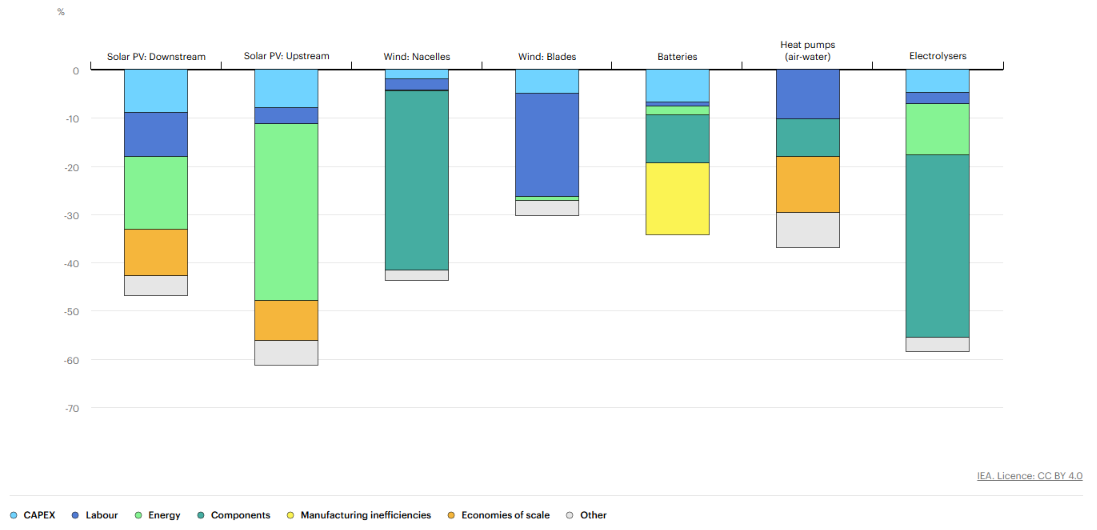
That reinforces this week’s thesis:
What happens inside the factory matters as much as where the factory is built.
🎙️ FROM THE SP SHOW: EXPERT PERSPECTIVE
Is Europe Losing Its Industrial Edge?
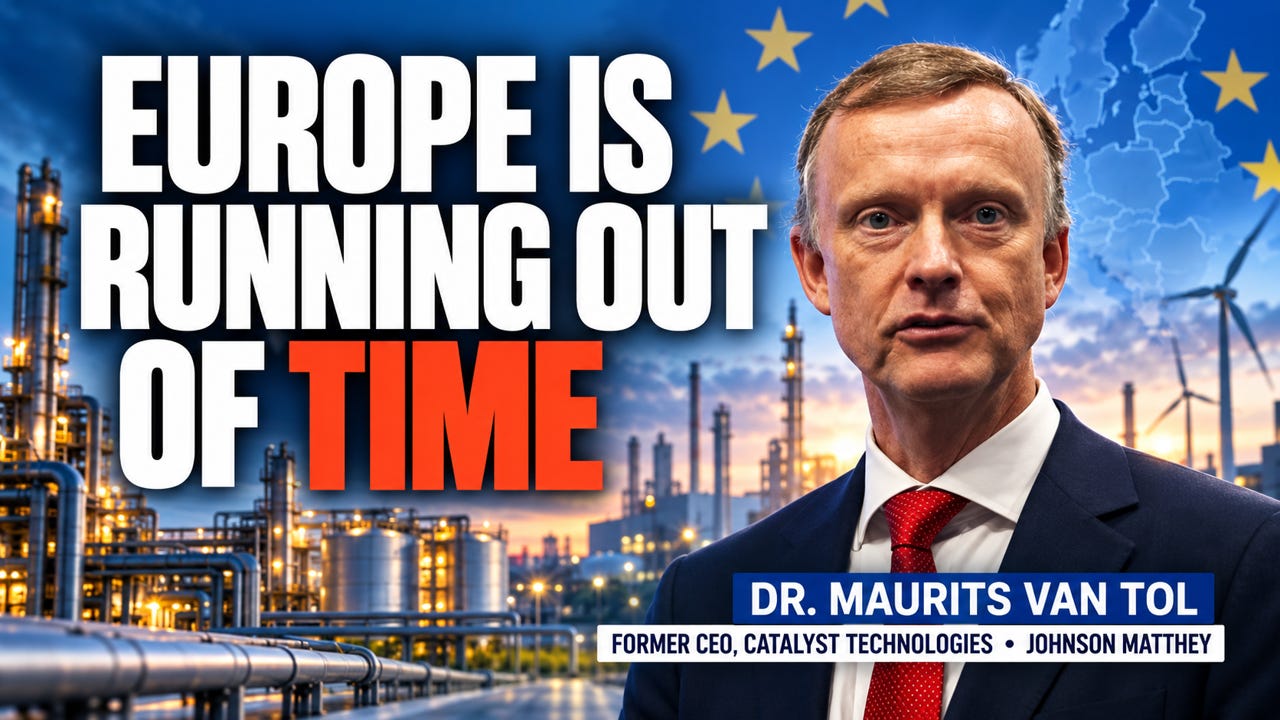
In the latest episode of The SP Show, Maurits van Tol examines a much bigger challenge facing European industry: competitiveness.
He points to chemicals as a warning, arguing that Europe’s share of global chemical production has fallen from around 30% three decades ago to less than 15% today, while high energy costs, fragmented markets and global competition put increasing pressure on manufacturing.
The parallels with batteries are difficult to ignore:
Building industrial capacity is one thing. Making it globally competitive is another.
Watch the conversation on The SP Show!
💼 BCP CORNER
From Battery Capacity to Competitive Manufacturing
As this week’s Deep Dive shows, the challenge is increasingly not simply building capacity, but turning technology and factories into competitive, qualified and commercially viable production.
Battery Consulting Partners supports companies across battery technology, manufacturing, cell qualification, due diligence, supply chains and strategic partnerships.
If you’re evaluating a battery technology, supplier, investment or market opportunity → Get in touch.
Visit https://batteryconsultingpartners.com/services/ for more info.
📅 EVENT PARTNER SPOTLIGHT
⚡ BATTERIES EVENT 2026 | 16–18 November | Lyon, France
Battery Vault is pleased to support Batteries Event 2026 as an official Media Partner.
The event brings together the battery value chain across materials, manufacturing, gigafactories, recycling, BESS, safety, next-generation technologies, financing and European competitiveness.
Battery Vault community members benefit from an exclusive 20% discount on visitor registration rates.
→ Explore Batteries Event 2026
👉 Media Partnership slots are available — [Contact us].
🤝 PARTNER WITH BATTERY VAULT
Reach decision-makers across batteries, EVs, energy storage, manufacturing, investment and supply chains.
6,000+ newsletter subscribers | 40,000+ industry community
Newsletter | Thought leadership | Executive interviews | Events | The SP Show
👉 To discuss partnership opportunities — [Contact us].
BEFORE YOU GO
Question of the Week
What is the biggest barrier to competitive battery manufacturing in Europe?
A. Energy costs
B. Manufacturing efficiency & yield
C. Materials & supply chain
D. Scale & factory utilisation
We would be particularly interested to see where the industry lands on this one.
Enjoyed this issue?
Forward it to one colleague working in batteries.
Subscribe on Substack:

Join our WhatsApp community: https://lnkd.in/eMgGgCxc
Subscribe to our newsletter here!
Until next week, take care!